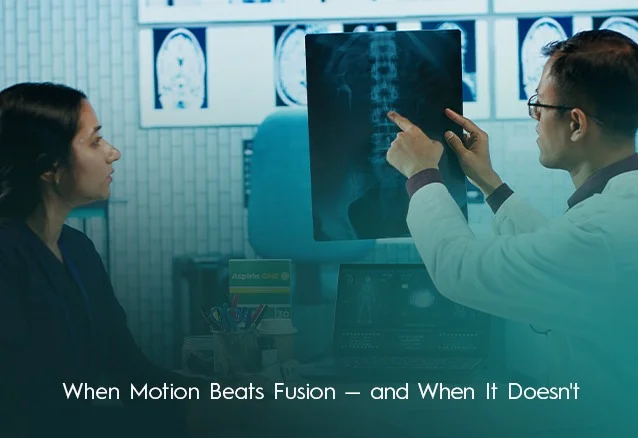
The most valuable thing a spine surgeon can tell you is sometimes the least expected: that you may not need the bigger operation.
For most of the last forty years, spinal fusion was the default answer for degenerative disc disease — solid, stabilizing, and effective at stopping pain, but at the cost of permanently eliminating motion at the treated segment. Motion-preserving alternatives — artificial disc replacement, or arthroplasty — were designed to keep the segment moving while still relieving pain. The promise was always intuitive. The question was whether the long-term data would hold up.
They now have up to twenty years of follow-up. So here is an honest, evidence-graded read of what the published literature actually shows — and, just as importantly, where it does not.
To keep it transparent, each finding below is marked by how strong the evidence is:
The neck (cervical spine)
In the cervical spine, the evidence base is now robust. Recent meta-analyses pooling 17–20 randomized controlled trials — several with 10- to 20-year follow-up — consistently report that cervical disc replacement preserves segmental motion and is associated with lower rates of adjacent-segment problems and fewer reoperations than anterior cervical discectomy and fusion (ACDF) in appropriately selected single- and two-level patients (Journal of Orthopaedic Surgery and Research, 2025; Journal of Neurosurgery: Spine, 2025). The trade-off reported across studies is modestly greater blood loss and longer operative time.
Two honest caveats belong here. First, a 2025 analysis found that industry funding measurably influences how cervical arthroplasty outcomes are reported — a reason to read individual trials critically rather than at face value (The Spine Journal, 2025). Second, while disc replacement at three or four levels looks encouraging out to seven years, that evidence is still retrospective and lies beyond the formally approved one- and two-level indication (International Journal of Spine Surgery). For multilevel disease, careful patient selection — not enthusiasm — drives the decision.
The lower back (lumbar spine)
The long-term lumbar data have matured impressively. The largest cohort to date — 1,187 patients followed 7 to 21 years — documents durable clinical improvement after lumbar disc replacement (Journal of Bone & Joint Surgery, 2025). A separate cohort followed nearly 14 years reported large, sustained reductions in back and leg pain and disability scores, with roughly three-quarters of patients returning to their original occupation (North American Spine Society Journal, 2025). A 2024 meta-analysis of ten studies found lumbar disc replacement to be at least equivalent to interbody fusion on complications and reoperations, with a modest advantage in residual back pain (Orthopedic Reviews, 2024).
Motion preservation is also expanding to the back of the spine. A posterior facet-replacement system became the first such device approved by the FDA, supported by a multicenter randomized trial against fusion showing preserved motion and favorable early outcomes (Journal of Neurosurgery: Spine, 2023) — relevant for stenosis and grade-I slippage, where fusion was long the only option.
Yet the lumbar story carries a genuine tension. The randomized evidence comparing disc replacement to fusion is statistically fragile — directionally consistent, but thin (Global Spine Journal, 2025). And paradoxically, the use of lumbar disc replacement has been declining in some health systems even as the long-term data improve — a reimbursement-and-culture gap rather than an outcomes gap.
So: motion or fusion?
The honest answer is that neither is universally "better." Each is right for a different patient.
Motion preservation tends to shine in the well-selected case: single- or two-level degenerative disc disease, preserved facet joints, reasonable alignment, and a patient for whom keeping the segment mobile genuinely matters. Fusion remains the correct, often superior choice for instability, deformity, advanced facet arthritis, or certain stenotic patterns — situations where stabilizing the segment is the treatment.
The real clinical work is not picking a favorite technology. It is matching the right patient to the right procedure — and, not infrequently, recognizing the patient whose best next step is no surgery at all. Imaging findings are not the same as the cause of pain, and a careful surgeon is as willing to recommend against an operation as for one.
What's still on the frontier
The most ambitious idea — reconstructing an entire motion segment by combining an artificial disc with artificial facet joints for a true "360-degree" motion-preserving repair — exists today only at the level of individual case reports and laboratory modeling. It is scientifically exciting and may shape the next decade of spine surgery. It is not standard care, and any responsible discussion of it should say so plainly.
The bottom line
Two decades of evidence have earned motion preservation a legitimate, durable place in spine surgery — particularly in the neck, and in well-chosen lumbar and facet-replacement cases. The honest framing is not "fusion is obsolete." It is this: there is now a real choice, the right choice depends on you, and you deserve a surgeon who will tell you which one fits — even when the answer is the smaller operation, or none.